The City of Wessex
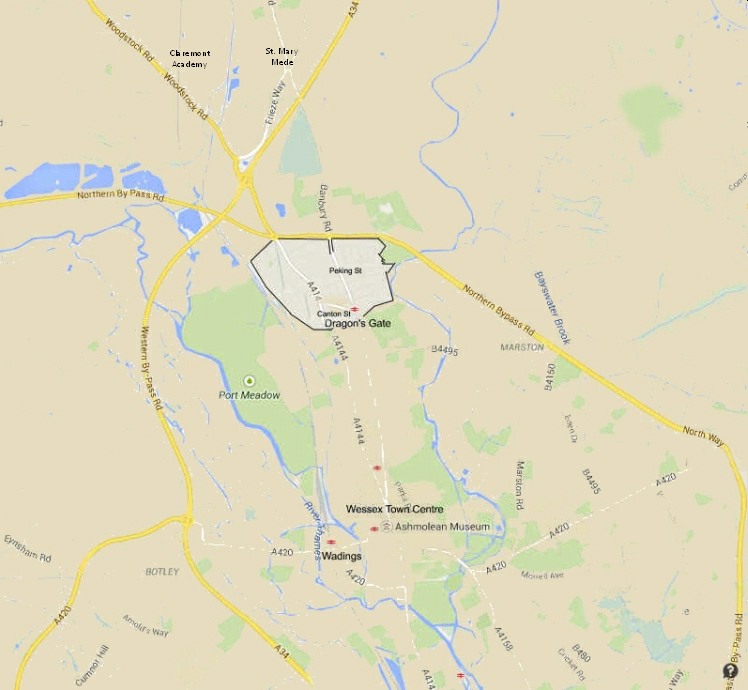
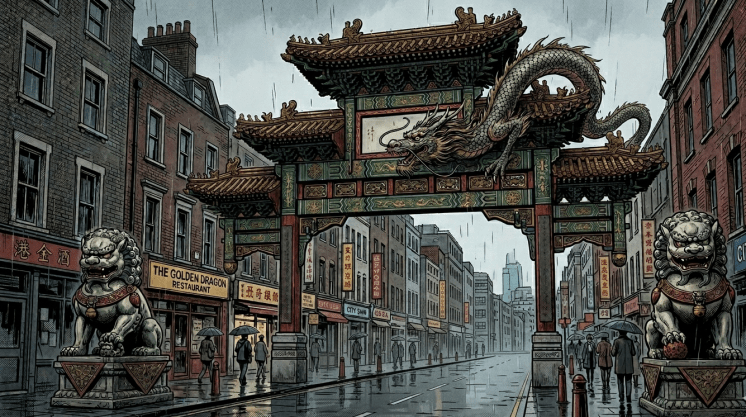
Port Meadow & Dragon’s Gate
Wessex County ~ Anglo-Saxon: “Kingdom of the West Saxons”
Wessex was an Anglo-Saxon kingdom in the south of Britain, from 519 until its emergence as part of a unified English state during the early 10th century.
The Anglo-Saxons believed that Wessex was founded by Cerdic the first King of Anglo-Saxon Wessex and his son Cynric, but it is possible that this account is a legend. Wessex became a Christian kingdom and during Cenwealh’s rule the territory of the West Saxons was expanded. A later king, Cædwalla, conquered the kingdoms of Sussex, Kent and the Isle of Wight. His successor issued one of the oldest surviving English codes of laws and established a second West Saxon bishopric. The throne then passed to a series of kings with unknown genealogies.
During the 8th century, as the hegemony of Mercia grew, the kings of Wessex were largely able to maintain their independence. It was during this period that the West Saxon system of shires was established which have remained to the present day though the boundaries have altered several times over the centuries.
The fortunes of the kingdom were transformed when Egbert conquered part of Dumnonia, seized control of Surrey, Sussex, Kent and Essex, conquered Mercia and secured the overlordship of the Northumbrian king, although Mercian independence was restored in 830. It was about this time that the fortress of Wessex was first built near an oxen ford near the border with Mercia and a town developed around the castle from the 900’s on. The fortress became an important military town on the frontier between the kingdoms of Mercia and Wessex and was on several occasions raided by Danes. During the reign of his successor Æthelwulf, a Danish army arrived in the Thames estuary, but was decisively defeated. When Æthelwulf’s son Æthelbald ascended to the throne, the kingdom was divided to avoid bloodshed. Æthelwulf was succeeded in turn by his four sons, the youngest being Alfred the Great.
When Wessex was invaded by the Danes in 871, Alfred was compelled to pay them to leave the kingdom. They returned in 876, but were then made to withdraw. In 878 they forced Alfred to seek refuge in the Somerset Levels, but were eventually defeated at the Battle of Edington. During his reign Alfred issued a new law code, gathered scholars to his court and was able to devote funds in building ships, organising an army and establishing a system of burghs. This is also the era of the last recorded independent King of the Cornish, (Westwealas) in 875. Alfred’s son Edward captured the eastern Midlands and East Anglia from the Danes and became ruler of Mercia in 918 upon the death of Æthelflæd, his sister. After Edward’s son Athelstan conquered Northumbria in 927, England became a unified kingdom for the first time. Cnut the Great, who conquered England in 1016, created the wealthy and powerful earldom of Wessex, which after 1066 was given as a prize to the Norman noble, Robert D’Oyly who moved his capital from Winchester to the ‘rebellious’ town of Wessex and substantially enlarged the castle.
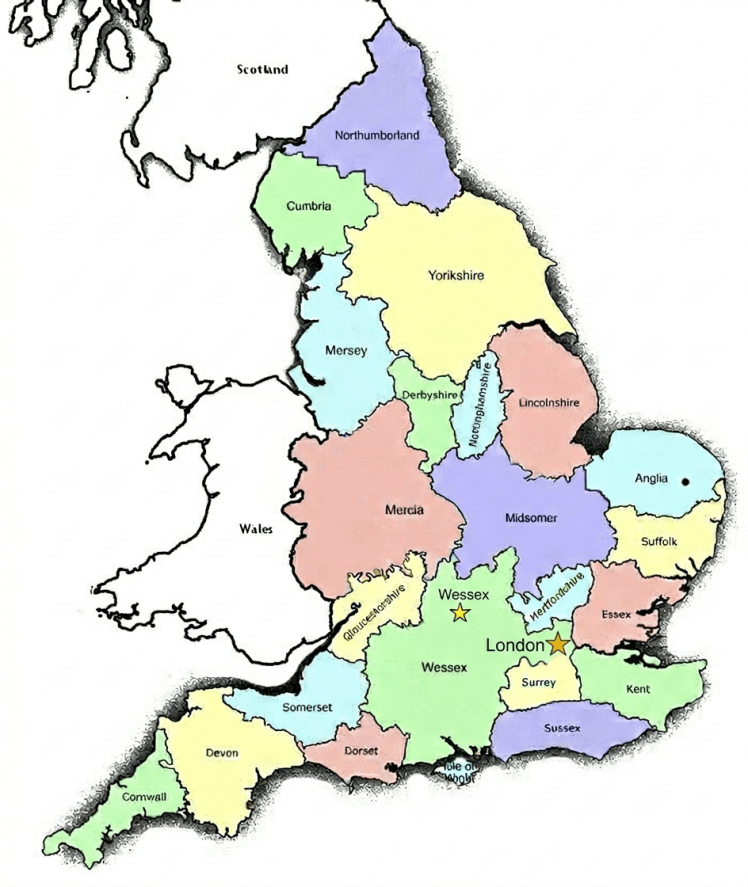
The system of shires which was later to form the basis of local administration throughout England (and eventually, Ireland, Wales and Scotland as well) originated in Wessex.
The City of Wessex
History: Wessex was first settled in Saxon times and was initially known as “Oxenaforda”. An important fortress was built there by Wessex sometime after 830 to hold the borderlands between Wessex and Mercia. It was the Mercians who first named the town Wessex given its importance in defending the kingdom and the name stuck. By 900 Wessex had become an important military frontier town and was on several occasions raided by Danes.
Wessex was heavily damaged during the Norman Invasion of 1066. Following the conquest, the town was assigned to a governor, Robert D’Oyly, who ordered the construction of Wessex Castle over the original Saxon fortress to confirm Norman authority over the area. The castle has never been used for military purposes and its remains survive to this day. The Earl D’Oyly set up a monastic community in the castle consisting of a chapel and living quarters for monks (St George in the Castle). The community remained small until after the second World War but it earned its place in history as one of the oldest places of formal education in the world; Wessex University. It was there that in 1139 Geoffrey of Monmouth wrote his History of the Kings of Britain, a compilation of Arthurian legends.
Wessex’ prestige was enhanced by its charter granted by King Henry II, granting its citizens the same privileges and exemptions as those enjoyed by the capital of the kingdom; and various important religious houses were founded in or near the city. A grandson of King John established Sanctuary Abbey for the Cistercian Order; and friars of various orders (Dominicans, Franciscans, Carmelites, Augustinians, and Trinitarians) all had houses of varying importance within the city walls.
The Abbey of St. Catherine was built in the 12th century and survived relatively intact from the Reformation.
During the English Civil War, Wessex housed the court of Charles I in 1642, after the king was expelled from London, although there was strong support in the town for the Parliamentarian cause. The town yielded to Parliamentarian forces under General Fairfax in the Siege of Wessex of 1646. It later housed the court of Charles II during the Great Plague of London in 1665–66. Although reluctant to do so, he was forced to evacuate when the plague got too close. The city suffered two serious fires in 1644 and 1671. In 1790, the Wessex Canal was built connecting the city with Coventry and London.
By the early 20th century, Wessex was experiencing rapid industrial and population growth. During World War I Wessex suffered severe bombing but only on the outskirts preserving the historic buildings. During an overnight attack on the 8/9 September 1915 a Zeppelin was reported shot down as it bombed a munitions factory which caused an explosion in which 35 women 40 people working in the factory were killed.
( see https://uksuperhero.com/2020/08/03/bluebook-session-60d-let-us-prey/ for explanation)
The printing and publishing industries became well established by the 1920s. Also during that decade, the economy and society of Wessex underwent a huge transformation as factories mass-producing cars and airplanes on the south-eastern edge of the city. During World War II, Wessex was badly affected by the German air raids during the Blitz, due to the presence of heavy industry and weapons manufacture in the area. The University’s colleges also served as temporary military barracks and training areas for soldiers before deployment. Then in 1940 both Wessex and London were subject to attacks by the Eugenics Brigade which resulted in further damage to the city.
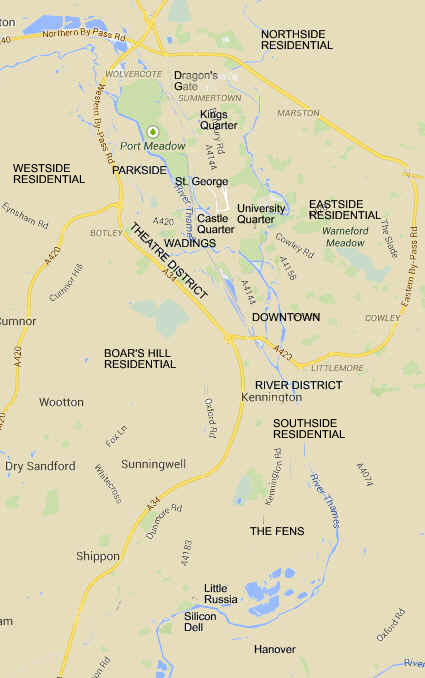
Following the War, Wessex was one of the locations chosen for expansion to house the growing population and the city quickly expanded from a population of 250,000 to a population today in excess of 1 million people (the third largest city in the UK) and the city underwent major renovation though as much of the historic city as possible was saved and rebuilt. The airport expanded, Europe’s first monorail was installed and Silicon Dell and the media district were established to the South of the city. The architecture of the city is a mix of ancient (particularly late Anglo-Saxon and Tudor), Georgian and 60’s skyscrapers with numerous parks and the River Thames running through the centre of the city.
Wessex is one of the most multi-ethnic cities in the UK with The influx of migrant labour to the car plants and hospitals, recent immigration from south Asia, and a large student population, have given the city a notably cosmopolitan character, especially in the Dragon’s Gate and Little Russia districts of the city. Wessex is located 50 miles (80 km) north-west of London and many local people commute.
 Superhero Adventures, UK Style