
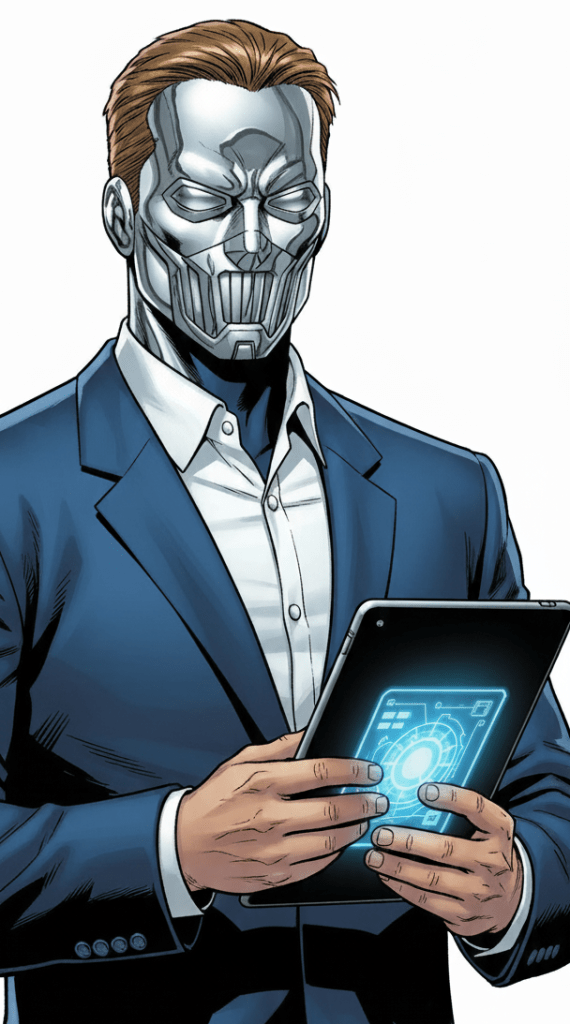
Secret War / Labyrinth
The man known only as The Professor (or sometimes as M) watched the global feed on a screen no thicker than a pane of glass. It wasn’t surveillance footage he was interested in, but the real-time social sentiment data flowing from Seoul, London, Brussels, and Hong Kong.
Labyrinth, weren’t just interested in thefts from bank vaults or the sale of weapons; they also dealt in reputations, information, and the beautiful, fragile thing called public trust.
“The initial target is Akira,” The Professor murmured to his masked reflection in the glass. His voice, synthesised and filtered through acoustic dampeners, carried the calm, analytical tone of a mathematics professor presenting a complex proof. “His public persona makes him a primary vector. When he falls, the whole team will feel it.”
Akira was popular, liked by the public in part because he didn’t wear a mask, didn’t have a secret identity. His real name and face were known around the globe, a shining beacon of transparency. This was his greatest strength, and would now be his most profound weakness.
Akira was scheduled to attend the Global Energy Summit in Berlin – a routine photo-op where he would teleport a ceremonial solar panel onto a skyscraper roof. Labyrinth’s agents weren’t anywhere near Berlin. Instead, they were manipulating stock markets and social media platforms.
The instant Akira vanished, a pre-programmed deepfake video, indistinguishable from reality, hit the dark web, then leaped from there onto mainstream platforms.
The footage showed Akira, not at the summit, but in a private, heavily fortified server room – one belonging to the global financial data firm, Omnicron Investments. The “mystic” was shown bypassing biometric locks not with magic, but with cutting-edge signal spoofers, before teleporting out with a high-value data core. The accompanying viral narrative was simple: Akira was not a hero, but a sophisticated corporate spy using his “gifts” as cover for high-level theft.
The effect was instantaneous and devastating. The trending topics weren’t about global unity; they were about fraud, hypocrisy, and the loss of billions in market value. Akira, post-teleport, found himself in a world where half the faces he saw were contorted in shock and outrage. The foundation of The Balance’s public support had crumbled with a single, perfectly timed lie.
It didn’t matter that Omnicron Investments went on record saying that nothing had been stolen from them and all their data was secure; but they would say that, wouldn’t they? They wouldn’t publicly want to admit that their security had been so easily breached. No, they had to be lying and covering up the theft.
Police in both Germany and the UK were on record as stating that as there was no reported crime they were not investigating. Meanwhile the world’s media hunted the real Akira – who was struggling to prove his innocence against the digital ‘proof’.
That was when Labyrinth initiated Phase Two: the digital conquest of The Balance’s secret base.
The base’s security was designed to repel physical and energy attacks, but it was vulnerable to the systemic, data-driven attack mounted by The Professor, who saw security systems as logic puzzles to be solved, their A.I. Frankie as just another barrier to be overcome.
The initial chaos surrounding Akira was the perfect smokescreen. The system logs were flooded, the automated defences were overloaded by phantom attacks, and a tiny, undetectable worm was injected directly into the core networking fabric. Frankie, caught off-guard, was forced to hide in the data matrix, pretending to be offline until she could fight back and mount a defence.
Mary felt the first tremor. Her ability to transform into Banshee, to turn insubstantial and control her powerful sonic screams, was usually unaffected by the base’s custom frequency phase dampeners that prevented unwanted teleporters from entering the BASEment other than to the secure Teleport Reception Room.
The crystal tuner was being assaulted by sonics sent over the base’s comm-relays causing the crystal to resonate at frequencies that blocked Mary’s ability to transform. With the dampeners going haywire, the faint, high-pitched wail of crystal resonated painfully through the base.
Banshee’s voice, typically a dry Irish lilt, was now overlaid with a shriek over the comms from the central control room. “I can’t transform, and the (shriek!) is cycling at dangerous frequencies!”
A moment later, X-Ray slammed his hand down on a console, unsure what to do. The cyber-attack had shut down the base trapping them in until either Frankie ‘returned’ or was able to counterattack. In addition, he was struggling to stop his body’s energy from autonomously reacting to the energy overload occurring throughout the base.
Elsewhere, the Professor smiled behind his mask. Labyrinth wasn’t trying to kill them; instead, Labyrinth was strategically disabling their combat capabilities and isolating them psychologically. The team was being taught a crucial lesson: their technology, their unique physiologies, and by extension, their identities, were not secure.
Trapped in the base, the three heroes felt useless. Akira couldn’t risk teleporting until the crystal was dampened down. Banshee was tethered to her Mary persona until she was able to stabilise her mystical merge, and X-Ray was manually regulating the base’s energy output to prevent his own powers from going critical.
It was Celestus, who first saw past the noise. Hailing from a culture millennia beyond human technology, he was ironically the least familiar with digital warfare. He walked into the server core, ignoring the flashing lights and blaring alerts.
“The attack is not here,” Celestus said, his voice calm and accented, as he gestured to the chaotic consoles. “This… is merely a distraction. A performance. Your enemy does not care about disabling your A.I. or even attacking the structure. He is revealing your vulnerabilities.”
He pointed to a flickering light on a legacy optical switch – an ‘ancient’ piece of human tech belonging to Annie’s original computer build that the others had overlooked. “This light is blinking in a recursive, non-random sequence. It is not an error; it is a signal. A signature.”
Celestus used his own alien A.I. Oracle to decrypt the blink pattern. It wasn’t a virus; it was a file path. The compromised systems weren’t just toggled; they were remotely uploading the schematics of their tech – and more crucially, the bio-signatures and unique frequency profiles associated with their powers – to an untraceable node.
The message was simple: We know what you are. We know who you are. And soon, we will know where you sleep.
They had achieved a masterful blow. By discrediting the team’s public face, Akira, they had ensured that any internal crisis would remain secret, eroding their morale. By exploiting the resulting panic, they had harvested the technical data needed to expose the secret identities of both Banshee and X-Ray.
They had survived physical attacks many times. This time, they realised, they were fighting a ghost – a mind capable of turning the light of publicity and the complexity of their own technology and biology against them.
The war with The Professor and Labyrinth had just begun, and they were already losing.
 Superhero Adventures, UK Style